First, what is specrails?
Most AI coding tools give you one assistant. SpecRails gives you a structured agentic team.
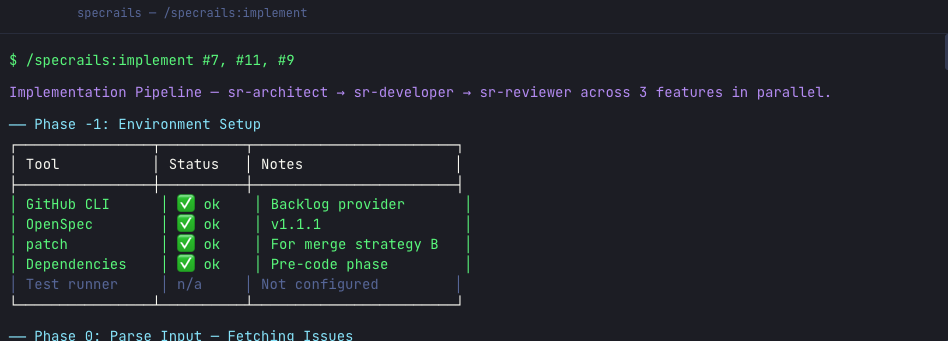
It sits on top of Claude Code and turns it into a pipeline of specialized agents: an Architect who designs the change, a Developer who implements it, a Reviewer who audits the diff, and a Ship phase that closes the loop (and others like Product Manager, Product Analyst, Security, Test Writer, etc). Each agent has a defined role, reads the context it needs, and hands off to the next.
The engine is specrails-core — an npm package that drops a .claude/ directory into your repo with agent definitions, command templates, and a spec-driven workflow (using the OpenSpec framework).
- I.e.: one command, /specrails:implement, runs the whole pipeline.
That covers writing code. Now we’re shipping what covers watching code get written.
From CLI to cockpit
specrails-core is the engine. What it’s missed until now is a windshield — a place to see what’s happening while the engine runs.
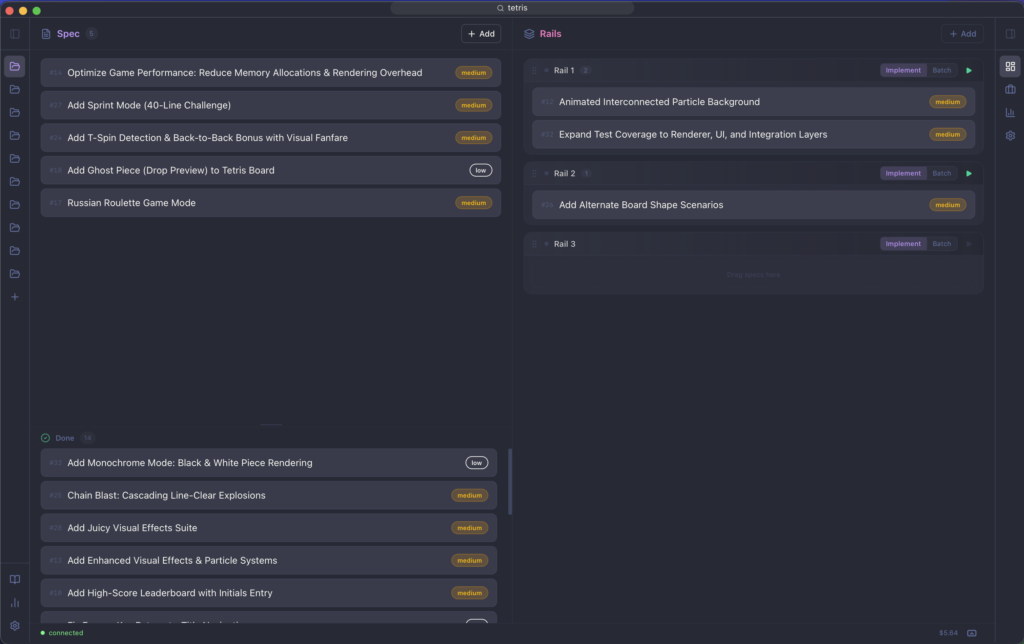
specrails hub is that windshield. A local dashboard and CLI for managing every specrails project you have, from one interface.
What it does
Multi-project hub. Register every repo using SpecRails. Switch between them with browser-style tabs. Each project runs its own job queue in parallel; jobs inside a single project run sequentially so phases don’t collide.
Live pipeline visualization. Watch Architect, Developer, Reviewer, and Ship phases update in real time. No more tail -f guessing.
Streaming logs. Every line of claude CLI output streamed to the browser over WebSocket. Pause, scroll, copy, keep going.
Ticket panel. Local tickets as List, Kanban, or Post-it views. Real-time sync with CLI agents — when an agent creates or updates a ticket, you see it appear instantly.
Command launcher. Discovery commands (propose-spec, auto-propose, auto-select) and Delivery commands (implement, batch-implement) grouped
logically. No more remembering flag order.
Analytics. Cost, duration, token usage, throughput — per project. See which repos burn the most Claude credits.
Native desktop app. macOS Apple Silicon today, Windows and Linux next. Built with Tauri, bundles the server as a sidecar — no separate install, no npm start.
Install it
Two options:
- Desktop app (macOS Apple Silicon): Click on “Download” in https://specrails.dev/
- CLI / browser:
npm install -g specrails-hub
specrails-hub start
open http://localhost:4200
Design principles
- Local-first. Everything lives in ~/.specrails/. The server binds to 127.0.0.1 only — your code, logs, and metrics never leave your machine.
- Per-project isolation. Each project gets its own SQLite database + a json spec backlog file. A stuck job in one repo can’t block another.
- Single WebSocket. One connection broadcasts all events, tagged with projectId. Simpler to debug, lighter on resources.
- No auth. This is a single-user developer tool — not a service. We didn’t build login, roles, or SSO because they don’t belong in a cockpit you own.
What’s next
Current roadmap:
- Codex support
- Windows + Linux desktop builds.
- Remote mode.
Changelog lives on every release. Follow this blog for the big ones.
If it saves you time:

Keeps us building!!
The SpecRails team